
 1 week ago
31
1 week ago
31
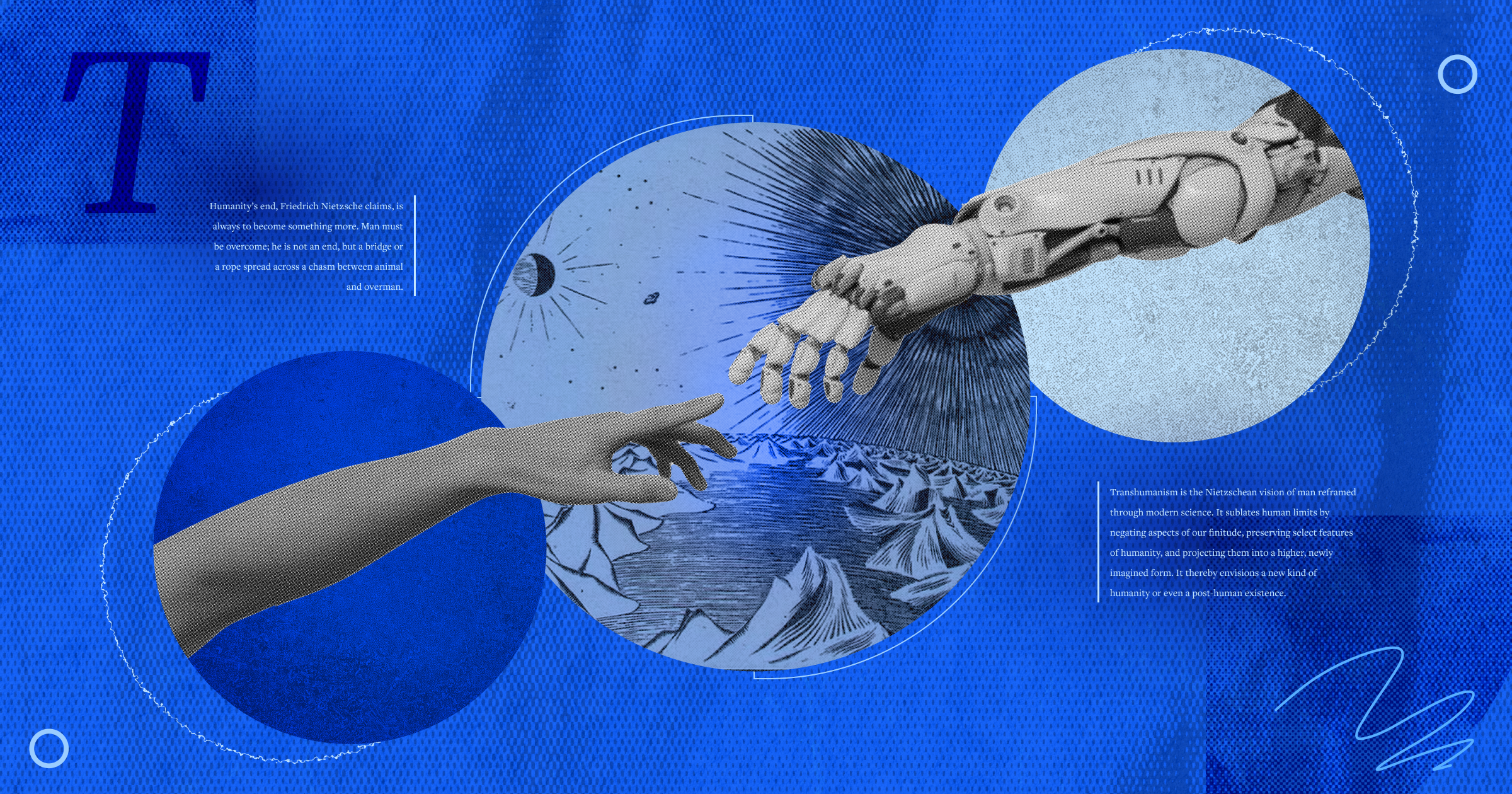
Humanity’s end, Friedrich Nietzsche claims, is always to become something more. Man must be overcome. He is not an end, but a bridge spread across a chasm between animal and overman (Thus Spoke Zarathustra, §3–4).
And what is this human bridge becoming? No one yet knows!
Transhumanism is the Nietzschean vision of man reframed through modern science. It sublates human limits by negating aspects of our finitude, preserving select features of humanity, and projecting them into a higher, newly imagined form. It thereby envisions a new kind of humanity or even a posthuman existence.
The Bible tells another story about what it means to be human. Scripture tells us God created us in his image with limits and ends that he himself has given us. While we should enjoy the gifts of technology to repair, augment, and improve our lives, we should also be aware of the limits God has given us. After all, I cannot flap my arms and expect to fly, but I can build a plane to carry me across the globe.
Table of contents
- What is transhumanism?
- What do transhumanists believe?
- What problem is transhumanism trying to solve?
- What does the Bible say about the nature & purpose of humanity?
- What does it mean to be made in the image of God?
- How does the Bible define human limits & dependence on God?
- Does transhumanism distort the Bible’s account of human identity?
- What ethical concerns arise from transhumanist goals?
- Is transhumanism compatible with Christianity?
- When does human enhancement cross the line into “playing God”?
- How should Christians discern between medical healing & technological enhancement?
- Conclusion
What is transhumanism?
Mark Coeckelbergh defines transhumanism as “The belief that humans should enhance themselves by means of advanced technologies and in this way transform the human condition: humanity should move to a next stage.”1
The language of transformation is why it is called transhumanism. While no one denies the goodness of medicine or technology to repair, augment, or extend our lives, transhumanism goes one step further by aiming to sublate human nature into a third thing: The process of transhumanism usually has its end in posthumanism. This will become clearer below.
What do transhumanists believe?
Transhumanists form a movement with specific goals. As Jacob Shatzer explains, “The transhumanist movement seeks to improve human intelligence, physical strength, and the five senses by technological means.”2 Perhaps the most well-known transhumanist advocate is Bryan Johnson, whose religious slogan is “Don’t die.” His desire is to overcome the ultimate limit of being human: death itself.

What problem is transhumanism trying to solve?
If humans are biological machines, then mastering humanity like we master nature is the goal. Whatever problem we encounter, whether infertility or mortality, we see it as a problem to be solved by technical expertise.
Hence, transhumanists use principles of physical science and apply them to humanity, as if we were machines or mechanisms. Bryan Johnson’s entire method is to min-max human biology through quantification so that he can find a way to avoid death, which is seen as a bug in a biological system to be corrected.
What does the Bible say about the nature & purpose of humanity?
The Bible tells us God created humans on the sixth day in his image in order to be fruitful, multiply, and fill the earth (Gen 1:26–28). Their vocation to tend and keep the garden through marriage and family makes concrete what Genesis implies about being human (Gen 2). To be human is to have what all other creatures have and more. We are made of matter like the earth. We grow like the plants. We live, reproduce, and move like the animals. But humans alone are in God’s image, containing within themselves the attributes of all creation while yet being more.
What does it mean to be made in the image of God?
To be in God’s image is defined in Genesis 1:28 as the human vocation to take dominion over all of God’s creation as stewards.
This status seems to be tied to the unique way in which God made humans, by breathing life into them (Gen 2:7). This in-breathing points to humanity’s elevated status in creation. Humans alone commune with God in the cool of the day (Gen 3:8). And God deals with humans for the sake of the whole world.
The particular limits and duties God gives via this image tell us what our life is about, what we are for. What is the chief end of being human? As the Westminster Catechism puts it, “To glorify God and enjoy him forever” through the natural (family, marriage, etc.) and gracious (gospel, Bible, etc.) gifts he has given us.

Use Logos’s Study Assistant to launch your study of ethical issues like transhumanism. Start your free trial.
How does the Bible define human limits & dependence on God?
The Old Testament teaches us two important lessons.
- God’s grace means that he intervenes to keep his people safe in a world that is dangerous and fallen. The book of Joshua, for instance, shows this reality as Israel conquers its enemies.
- God judges or punishes by permitting us to live without his supernatural grace to protect us. The book of Judges, in contrast, shows this side of reality. Without God, we can do nothing.
Without God, the world would be in chaos. And because of our rejection of him, we suffer greatly and ultimately will die (Gen 2:17).
While God has given humans good gifts such as music, metallurgy, poetry, ranching, and city infrastructure (e.g., Gen 4:17), he will sometimes allow us to bump up against our natural limits for our spiritual good. So the matriarchs in Genesis often were barren, and God commanded Abraham to sacrifice his son Isaac as a test (Gen 22). But God works through these limits so that we would rely on him. Our spiritual good comes from knowing our natural limits and relying on God’s grace to bring us through them. We count it all joy when we go through various trials, James explains, because it will make us complete (Jas 1:2–4).
Our spiritual good comes from knowing our natural limits and relying on God’s grace to bring us through them.
Does transhumanism distort the Bible’s account of human identity?
It can, but only under the following criterion: Does the transhumanist goal sublate or bypass our God-given natural limits, and so inhibit our spiritual growth?
How does Scripture describe human suffering, weakness, and mortality—and should these be “overcome” through technology?
We generally call medical techniques good when they can restore the function of our organs. A good heart surgery restores the function of the heart. And in God’s common grace, he grants us technological success that promotes life. We can even see this in the evil city of Enoch, which had metallurgy, ranching, poetry, city infrastructure, and more (Gen 4:17–26). While evil, God’s grace preserves all due to his mercy. Therefore, Christians should be life-affirming, which means affirming all the technological advancements that benefit life.
At the same time, we must recognize that denying what it means to be human by, say, uploading our brains to a data center to become immortal machines denies the way in which God created us to be human.

What ethical concerns arise from transhumanist goals?
Since transhumanists generally describe human limits (particularly death) as something to be overcome, we can agree with them on what humanity’s ultimate problem is. But we see a different resolution as Christians. Death is the punishment for sin, and Christ rose from the dead so that we might have eternal life (e.g., Rom 6:23).
For this reason, while we do not welcome death, we also see it as a just wage for our sin. It is the last enemy, and we hope in Christ to overcome it. We use medicine to prolong life, to be sure, but we do not hope to become a different kind of human (machine, virtual, or otherwise) to avoid death. We believe our soul is immortal and persists after bodily death.
Is transhumanism compatible with Christianity?
In its more extreme versions, it is not. God tells us who we are (creatures), what we are (image bearers), and what we are for (to be fruitful, multiply, fill, take dominion, etc.). The transhumanist goal to transform humans into something else would contradict God’s intent for us. A goal that would bypass God’s given limits on our human nature may prevent us from spiritual growth, which matters for eternity.
At base, changing one’s body by surgery according to a posthumanist agenda, apart from medical necessity, is incompatible with Christianity. Paul says, “For no one ever hated his own flesh, but nourishes and cherishes it, just as Christ does the church” (Eph 5:29). But transhumanist activities that aim to upload consciousness or recreate the human body imply a “hatred of his own flesh.” That hatred is against nature, the nature God has given us.
Some forms of transhumanism perhaps could work alongside Christianity when its goals parallel medical ethics: to augment, repair, or otherwise support natural ability and organisms. But then we would ask whether or not this activity is truly transhumanist or if it just appears to be.
When does human enhancement cross the line into “playing God”?
When we select by gene therapy which fetus lives or dies based on certain traits (height, IQ, etc.), we position ourselves as masters of life and death. But God alone has power over life and death (Deut 32:39). Further, we undermine the worth of those traits purposefully unselected, devaluing any human life that possesses such traits.
Additionally, anytime we sublate some given human limit or add something that is new to humanity, and become a third thing, we are in danger of defining ourselves in ways that God does not.
How should Christians discern between medical healing & technological enhancement?
Medicine traditionally seeks to heal, repair, and restore the healthy function of the body. So a pacemaker, although technological, restores the function of an organ. The same is true for prosthetics. Technological enhancement may promote medical healing, and we should not object to that, per se.
However, some medical enhancements will seek to bypass nature in ways that do not restore but aim to refashion one’s own flesh. I think of height augmenting surgery to lengthen one’s legs. Such an enhancement appears to amount to hatred of one’s own flesh (Eph 5:29) and denies the natural limits God has given us.
Conclusion
Oliver O’Donovan explains,
Christians should at this juncture confess their faith in the natural order as the good creation of God. To do this is to acknowledge that there are limits to the employment of technique and limits to the appropriateness of our making. … Technique, too, must have its sabbath rest.3
I agree with his judgment. God made the world with limits that we must be wary of breaching through our pursuit of freedom and our mastery of nature.
While technology is a gift of God’s common grace, any good thing can be misused. Poetry is beautiful, and the first poem in the Bible is a love poem (Gen 2:23). The second poem in the Bible is a vengeance poem that drips with murderous desire (Gen 4:23–24). The technique of poetry is good, but it can be misused and abused. Likewise, I believe that much of what falls under transhumanism falls under the category of misused gifts. Christians should be as wise as serpents as we enter into an ever more technological age.
Wyatt’s recommended reading
- Ellul, Jacques. The Technological Society. Translated by John Wilkinson. Vintage Books, 1964.
- Grant, George. Technology and Empire: Perspectives on North America. House of Anansi Press, 1969.
- Lewis, C. S. The Abolition of Man. HarperOne, 2001.
- O’Donovan, Oliver. Begotten or Made? Davenant Institute, 2022.
Additional resources on technology and transhumanism
Transhumanism and the Image of God: Today’s Technology and the Future of Christian Discipleship
Save $9.00 (36%)
Price: $15.99
-->Regular price: $15.99
Modern Technology and the Human Future: A Christian Appraisal
Save $10.00 (33%)
Price: $19.99
-->Regular price: $19.99
Crossing Wires: Making Sense of Technology, Transhumanism, and Christian Identity
Save $4.01 (18%)
Price: $17.99
-->Regular price: $17.99
Technē: Christian Visions of Technology (The Center for Pastor Theologians Series)
Save $7.00 (20%)
Price: $26.99
-->Regular price: $26.99
Confronting Technology: The Theology of Jacques Ellul
Save $13.95 (45%)
Price: $17.05
-->Regular price: $17.05
From Babel to AI: Idolatry, Transhumanism, and the Crisis of Imago Dei
Save $13.95 (45%)
Price: $17.05
-->Regular price: $17.05
Reaching for Immortality: Can Science Cheat Death?: A Christian Response to Transhumanism
Save $6.00 (40%)
Price: $9.00
-->Regular price: $9.00
Related content
- What Is Christian Ethics? How Scripture Shapes Our Moral Lives
- What Does It Mean to Be Human? Theological Anthropology
- It’s Not What You Think: Exposing the Limits of Technology
- Bioethics from Embryo to Deathbed: Right, Wrong, and Healthcare
- 10 Arguments Against Physician-Assisted Suicide







 English (US) ·